Hello sweet souls,
As I write this, we are standing at the threshold of the trecena of Ajmak—the nawal of forgiveness, of grace, of the softening that becomes possible when we finally stop holding ourselves so tightly to account, when we gently ask for forgiveness.
Ajmak is the day of the ancestors and the pardoned. It is the nawal that asks us to look honestly at what we have been carrying—the weight of our own self-judgment, the stories we inherited about who we are allowed to be, the ways we have made ourselves smaller than we were made—and to lay it down. Not to explain it. Not to justify it. Simply to set it at the altar and receive the grace that has been waiting for us.
This is not about perfection. Ajmak never is. It is about being willing to be human—imperfect, tender, still becoming—and forgiving yourself for the whole of it.
And because this is 1 Ajmak, we are at the very first breath of this pardoning—its inception, its seed. We are not asked to complete the forgiveness today. We are not asked to have it all resolved. We are asked only to begin the softening. To say, for the first time or the hundredth time: I am willing to receive grace.
Yesterday, I asked whether you will accept the calling that was planted in you. August is the month we sit with that question—not as a demand, but as an invitation. And Ajmak is where the acceptance becomes possible, because you cannot fully claim what was given to you while you are still holding yourself in judgment for all the years you didn’t. Ajmak is where that loosens. In here, at the altar, in the quiet moment you allow yourself to say: I receive this. I receive myself.
I want to tell you something small that happened, before this altar was even lit.
I walked through the Santa Fe farmers market carrying these two enormous bunches of marigolds. A woman passed me, beaming, and said, “Beautiful flowers.” A man smiled sweetly at me with my bundles. And I thought—that is Ajmak. The sweetness doesn’t wait for the ceremony. It moves through you the moment you say yes to it.
I will see the members of The Altar online for our Cacao Ritual with Ajmak today, Thursday, August 6 at 11:00am MT on Zoom. We will open with Cacao and move into a guided meditation on acceptance. If you’d like to join us, become a member of The Altar.
However you meet this trecena—at your own altar, in your own quiet, with your own open hands—may the grace you have given others finally find its way home to you.
There’s a little video of the flickering altar down below.
With you in the pardoning,
Maggie
The Altar for Ajmak
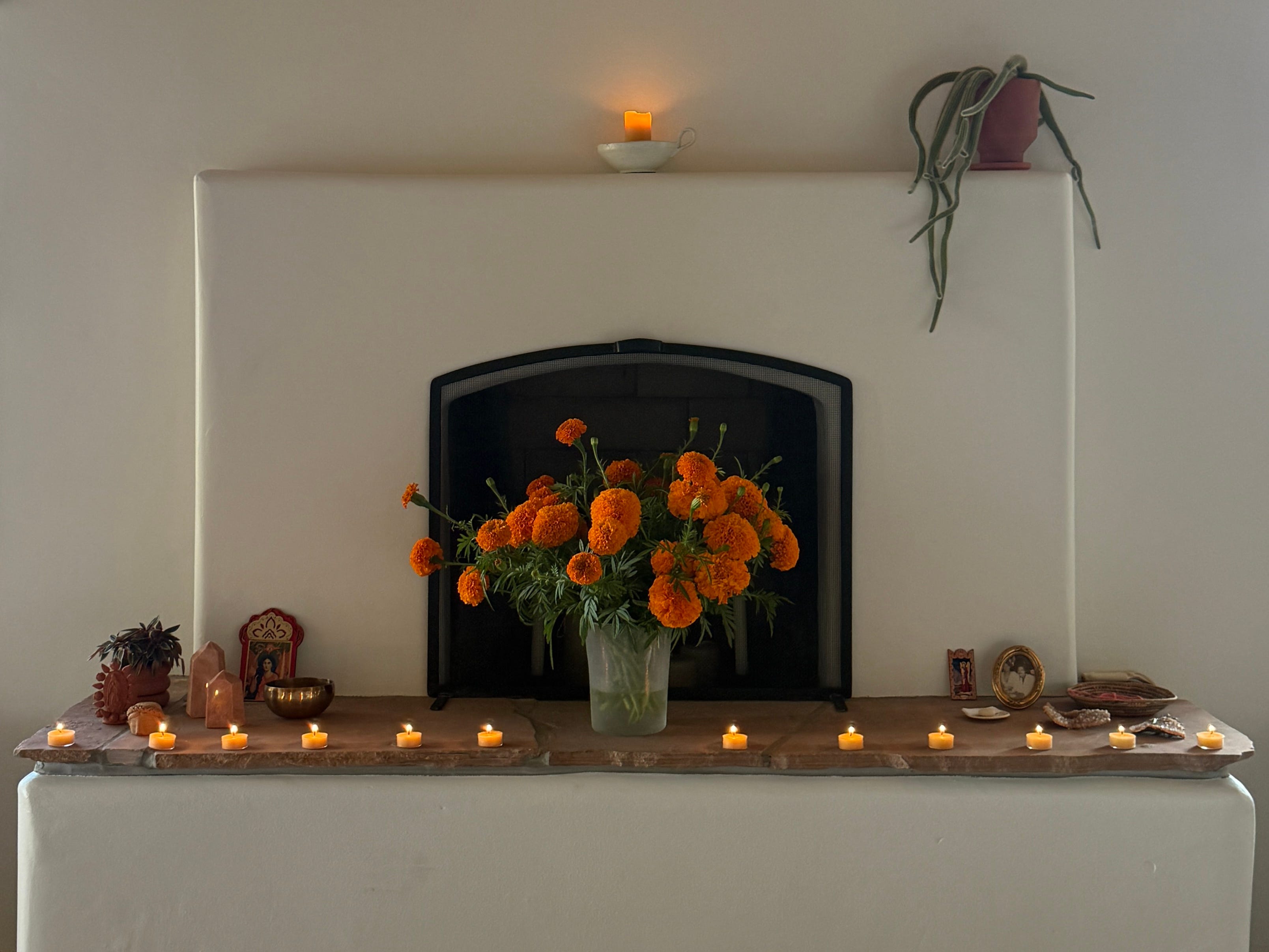
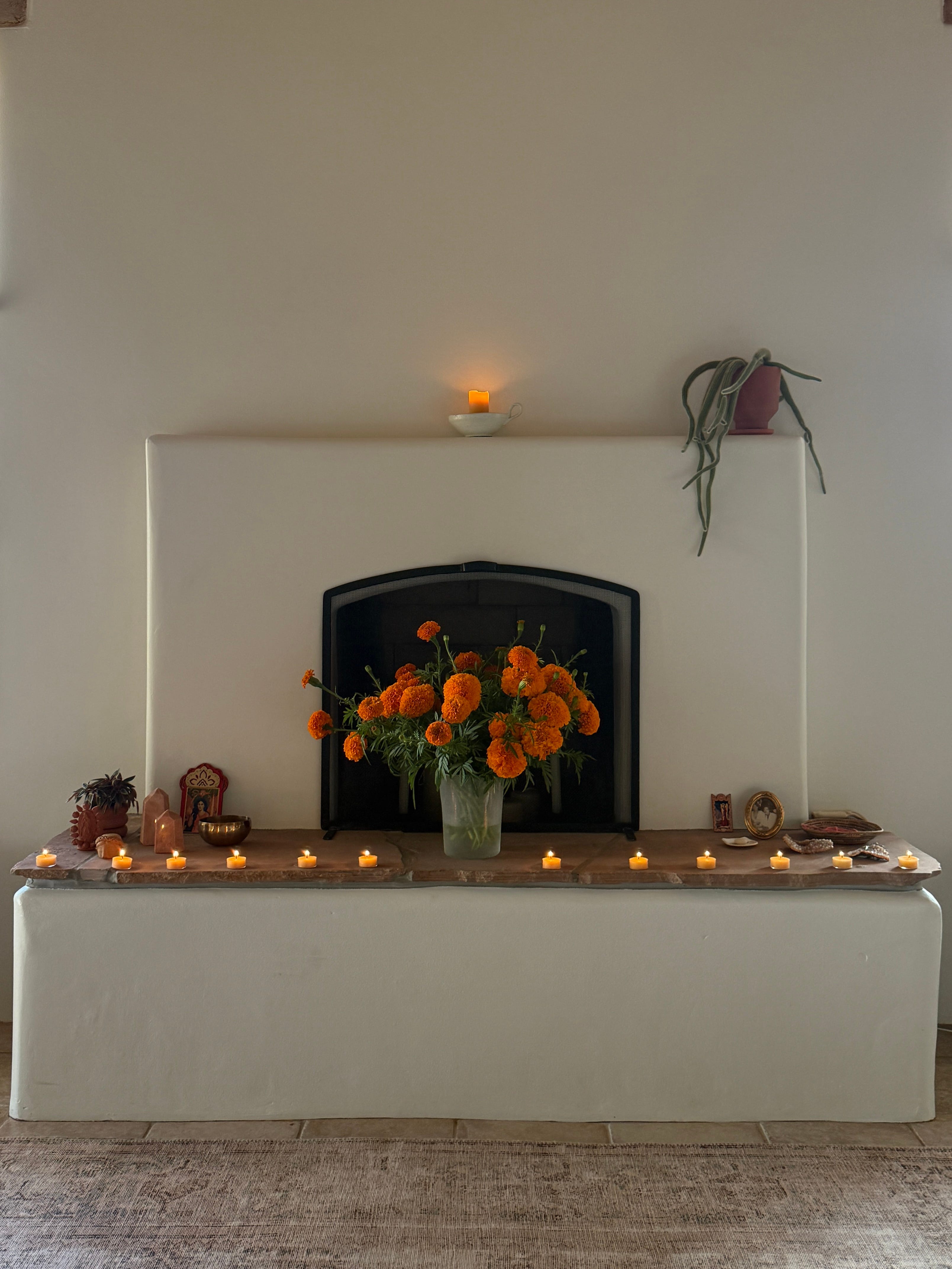
I built this altar at the threshold, as the trecena opened.
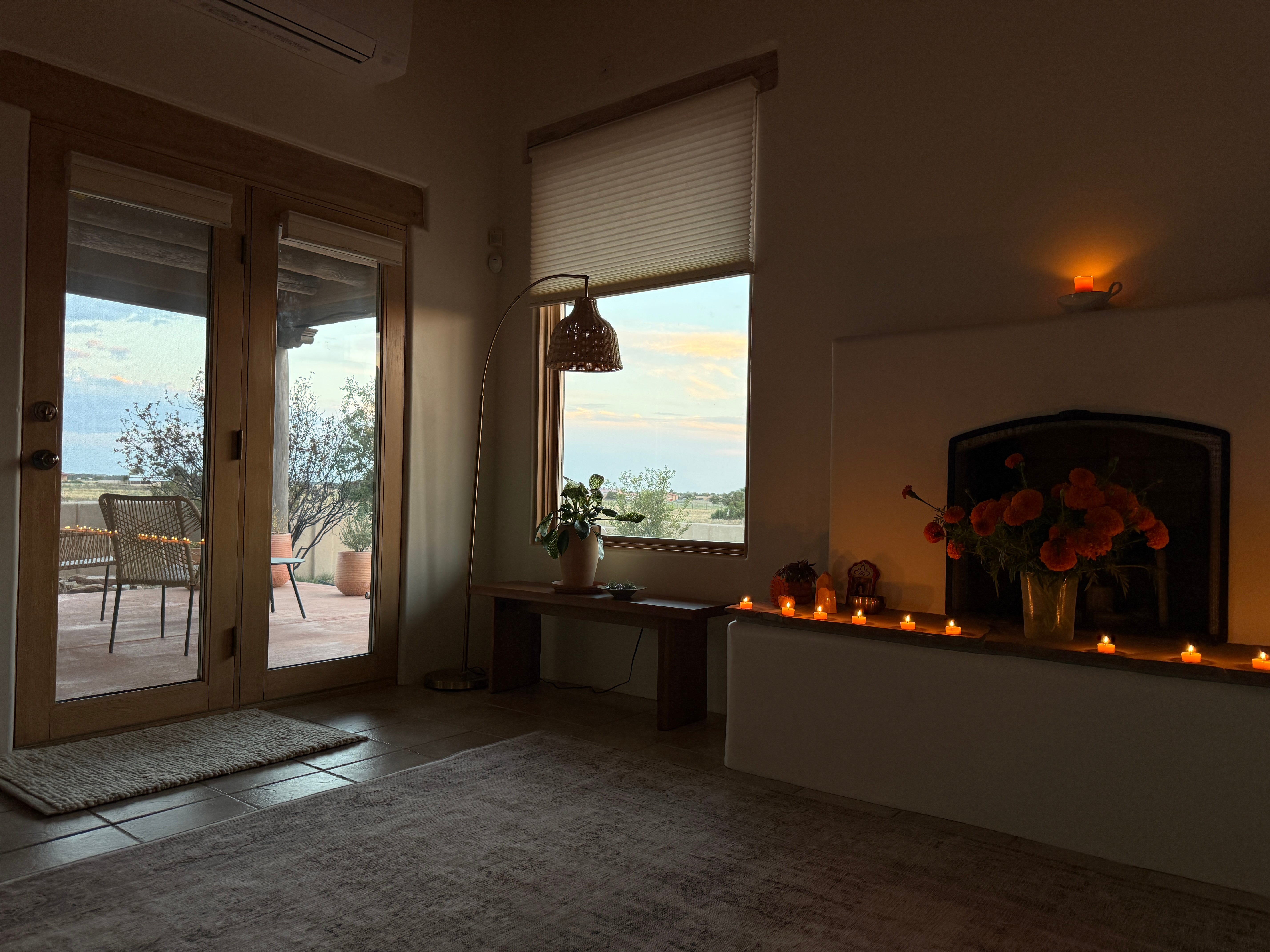
The base is the mantel of my fireplace—long raw stone, the color of the high desert. It needed nothing added. The land itself is the cloth.
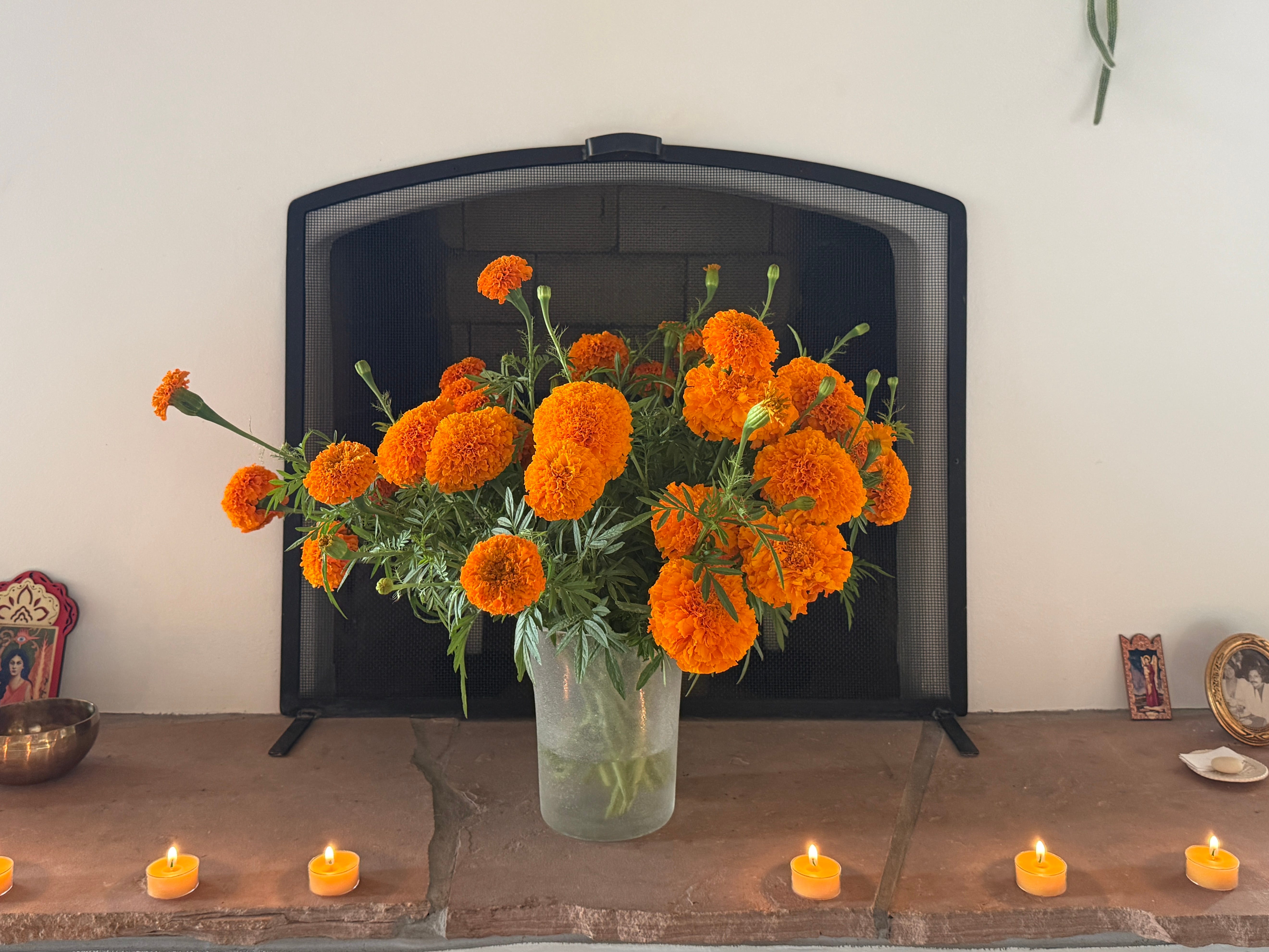
At the center stand the marigolds. Two enormous bunches spilling gold and deep amber-orange from a frosted glass vase—more than I could hold in two hands. In the traditions of this lineage, marigolds are the flower of the beloved dead, placed to call the ancestors home. Here, they carry that meaning and one more: they are the color of Ajmak itself, the warmth of grace, of what opens when we finally stop bracing. I wanted them overflowing. Because that is the instruction for this trecena: take up as much space as you were made to fill.
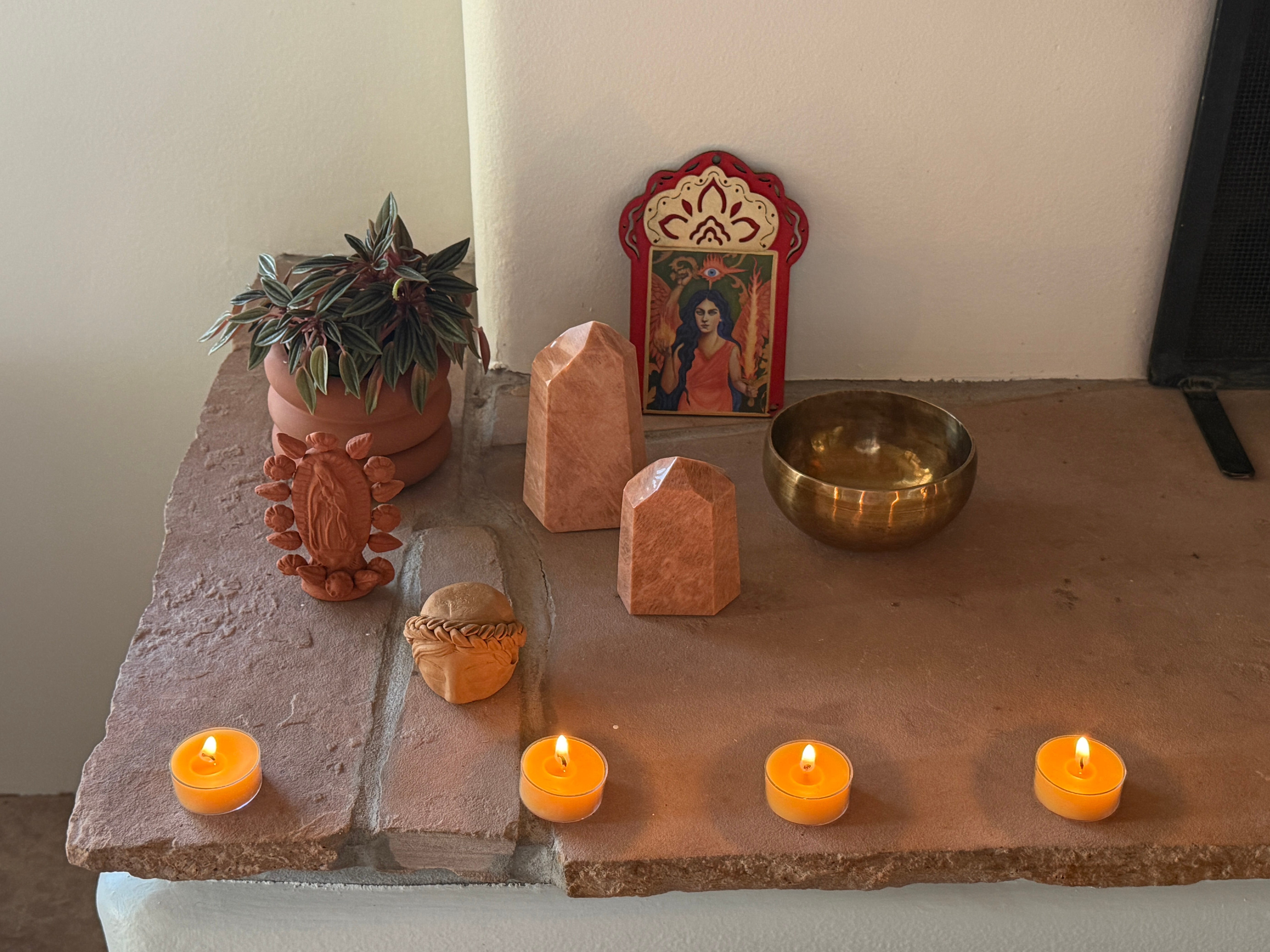
The sound bowl rests near a living plant—a reminder that this altar breathes. Sunstone towers stand close, inviting softness. The archangel Uriel in a red arched frame holds fire in both hands. She is the one who can hold the light of her own becoming without flinching. The small Guadalupe in terracotta, arms open—the mother who pardons, the one who has never once asked you to earn your way back.
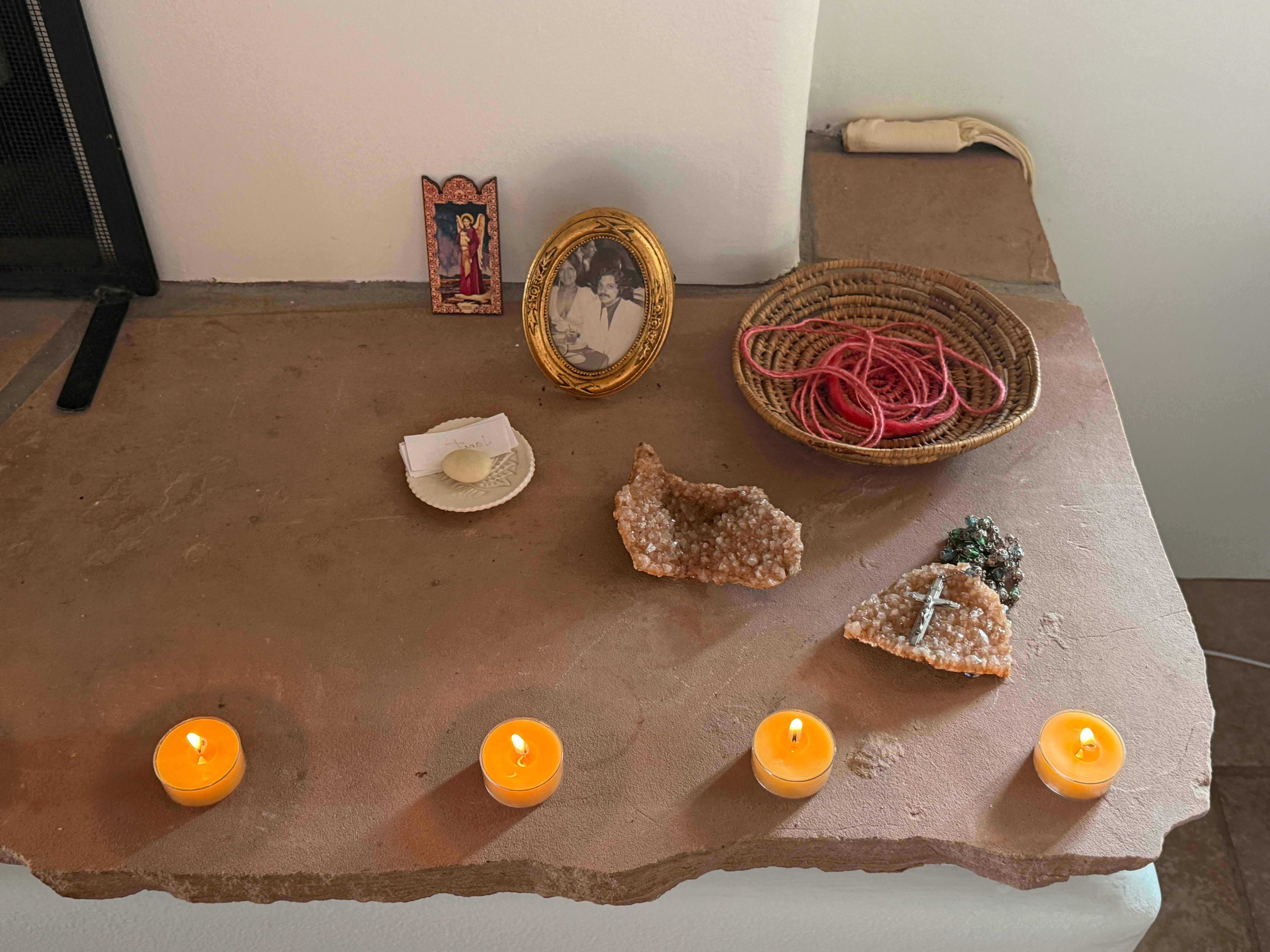
My parents in the oval gold frame—young, luminous, at a table together. I receive what they gave me and release what was never mine to carry. My mother’s rosary is draped across the pink amethyst crystal clusters, the silver cross catching the light. It found its place. That is how her love works. The woven basket with its pink spiral center holds what is being gathered: everything that becomes available when we say yes to ourselves.
In the white dish, held by a stone, are the names of everyone in The Altar—the whole community carried into this trecena, all of us given permission to receive grace.
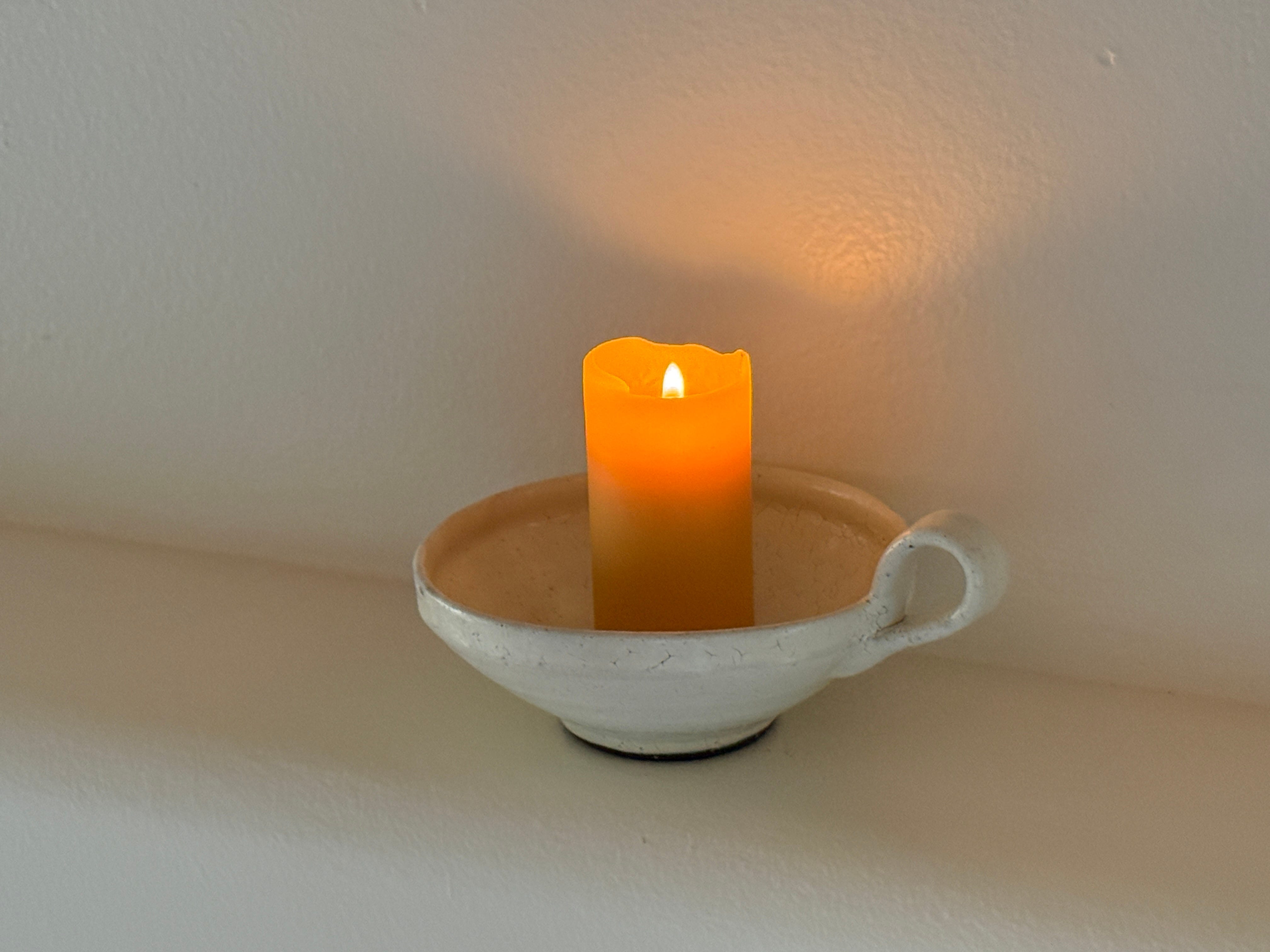
And then the fire: twelve beeswax tea lights across the full length of the mantel, one flame handed to the next. The thirteenth—a tall pillar—sits alone in its white ceramic holder on the mantel above, elevated, watching over everything below. The bee belongs to Ajmak, and beeswax has been on this altar through every trecena. But here I want to name it: the sweetness of honey is this day’s deepest promise. These candles are not only light. They are the sweetness of this life, returned to us the moment we stop withholding ourselves from it.
Why the Sound Bowl—Listening in Both Directions
Most of us were taught to listen outward—for instruction, for approval, for the signal that we were doing it right. Many of us have been slowly learning to listen inward instead. But Ajmak asks for both at once.
When you strike a singing bowl, the resonance doesn’t travel in one direction—it expands into the room and into your body simultaneously. It reaches for everything. That is how the ancestors speak: not only inward, not only outward, but in the field between, where your Soul and their love meet.
Forgiveness works the same way. You soften, and the softening is received. You say I accept myself, and something on the other side says we have been waiting for you to believe that.
The bowl holds the vow. The grace returns as resonance.
Creating Your Own Altar for Ajmak
If you are building your own altar for this trecena, let grace be your guide. Ajmak does not ask you to have forgiven everything or accepted everything before you sit down. It asks only that you be willing. Willingness is the whole beginning.
If you are working with acceptance—if there is a calling, a gift, an aspect of yourself that you have been circling but not yet claimed—write it down and place it at the center of your altar. Not as a demand, not as a task, but as a permission. I am allowed to be this. I am allowed to want this. I accept what was planted in me. Lay it there and let Ajmak tend it for thirteen days.
If you are working on showing yourself more grace—if your inner voice has been harsher than you would ever be to someone you love—place something soft on your altar. A cloth that feels gentle under your hand. A flower you’ve opened all the way. Something that reminds you of tenderness, and let it be directed at you. You are worthy of the same softness you offer others.
If you are working with compassion—toward yourself, toward an ancestor, toward someone whose thread is tangled in yours—place a photograph, or write a name, and let the altar hold the relationship without you having to resolve it. Ajmak does not ask you to have the answer. It asks you to stop hardening against the question.
If you are seeking to allow more of the sweetness of this life—if you have been bracing, withholding, waiting until you’re more ready or more worthy or more certain—bring something golden to your altar. A gold cloth, a marigold, a bowl that catches the light, honey in a small dish. Let the color remind you that the sweetness is not a reward for getting it right. It is what opens when you stop keeping yourself from it.
If you are working with Ajmak’s color, bring yellow or gold—and let it be warm rather than bright, amber rather than sharp. A marigold opened wide. A beeswax candle glowing. A cloth that holds the color of late afternoon. That warmth is the feeling you are practicing: receiving the grace that was never actually withheld from you.
If you are sitting with the question of what you are ready to forgive yourself for—write it down. Not as a confession, but as a release. Lay it at the altar. You do not have to read it again. Let Ajmak receive it and begin, over these thirteen days, to soften what has been held.
A marigold. A candle. A slip of paper with your permission written on it. A bowl to hold what you are receiving. These are enough.
Let your altar be the place where you finally give yourself what you have always deserved to receive.
Let it remind you that the grace was never something you had to earn—it was only something you had to turn toward.
And so it is—Maltiox, Maltiox, Maltiox.